




.svg)


Company leaders should think strategically about office design rather than blindly follow the latest fads. Too often, "modern" is used as a shorthand for "open," but a trendy layout that ignores your team’s actual workflows is a liability, not an asset. Work environments reflect and reinforce core values through layout, aesthetics, and functionality. When a space is designed with intention, it becomes a silent partner in your business—a physical tool used to influence behaviors, boost morale, and drive bottom-line performance.
For instance, open floorplans aim to encourage collaboration, a virtue for many modern companies looking to break down silos. However, we’ve learned that complete openness often yields the opposite result: it reduces privacy and creates "noise fatigue," which actually hampers productivity and drives employees to wear noise-canceling headphones—the ultimate barrier to collaboration.
The solution isn't to retreat back to 1990s cubicles, but to find a dynamic equilibrium. This likely entails balancing open communal areas—designed for serendipitous "water cooler" moments—with enclosed quiet spaces for deep, concentrated work.
The "perfect" office doesn't exist in a vacuum; the optimal balance depends entirely on your specific work patterns. A high-intensity sales floor requires a different energy and layout than a software engineering firm or a creative branding agency.
To move beyond guesswork and "Pinterest-inspired" decorating, an organization must take a data-driven approach. You can systematically evaluate your team’s unique needs by applying a “Collaboration and Quiet Index” across seven key spatial attributes. By scoring your current or future space against these metrics, you transition from "subjective taste" to "objective strategy."
This isn't just about where the building is, but where a team sits within the floorplate. Central visibility creates a "town square" vibe, perfect for departments like HR or IT that everyone needs to access. Conversely, distributed team zones (or "neighborhoods") allow specific departments to build their own micro-cultures and reduce "cross-talk" noise from unrelated teams.
Enclosure dictates the level of acoustic and visual privacy. Open layouts prioritize "information osmosis"—hearing things by accident that help you do your job. Closed rooms are for the "deep work" Yodle identified. The goal is to provide a gradient: from totally open desks to semi-private booths, to soundproof pods.
This deals with the "Goldilocks" of human interaction. High-exposure areas are public gathering spots (like Adobe’s transparent hubs) where you expect to be seen and interrupted. Low-exposure areas are tucked away nooks or "library zones" where an employee can work with their back to a wall, reducing the "cocktail party effect" and anxiety of being watched.
As Adobe discovered, space must support both in-person and virtual collaboration. This factor asks if a space is "analog-first" (whiteboards and face-to-face) or "digital-first" (integrated screens for Zoom/Teams). Great design ensures that a group sharing a screen doesn't disturb those using personal devices nearby.
This defines the "rules of engagement." Reservable spaces provide certainty for planners and high-stakes meetings. First-come-first-served (hot-desking or touchdown spots) encourages spontaneity and movement. Balancing these prevents "squatting" in meeting rooms while ensuring people have a "home base" when they need it.
Humans have a biological need for "Prospect and Refuge." Panoramic views (windows, long vistas across the office) provide a mental break and inspire big-picture thinking. Focused sights (staring at a task-lit desk or a solid wall) help the brain enter a "flow state" by removing peripheral visual distractions.
One size never fits all. Large assemblies (like Yodle’s stadium seating) are for cultural alignment and "Town Halls." Small huddles (2-4 people) are where the actual engine of work happens. A common mistake is building too many 10-person boardrooms that are usually occupied by only two people.
Analyzing regular activities like standing meetings using these metrics provides concrete vocabulary for articulating needs beyond generic calls for “more collaboration.” Surveys, workshops, and other input can also illuminate trends.
Adobe, a company that faced similar challenges to what you might be experiencing right now. They were looking to reinvent their office space in Midtown Manhattan, seeking to create an environment that would not only draw employees back into the office but also support their dynamic work culture.
The starting point for Adobe—and a great one for any company—was to recognize that simply asking for "more collaborative space" wasn't enough. Instead, they needed to understand the specific needs and preferences of their employees. What Adobe did next was both insightful and effective, and it's a strategy that could benefit your company as well.
Firstly, it's about truly knowing your employees. Who are they? What are their workstyles? How do they interact with the space? Adobe took a data-driven approach to answer these questions, engaging directly with their employees to gather feedback on what matters most to them in a workspace.
They found out that employees craved a space that was not only functional but also had a sense of transparency and connection to the activities happening around them. They wanted technology-integrated spaces that allowed for seamless sharing of ideas, supporting both in person and virtual collaboration. Additionally, they expressed a desire for informal and flexible meeting areas for spontaneous teamwork.
While open-plan offices are popular, Adobe's employees also highlighted the importance of having clear boundaries and distinct areas for different teams and tasks. This nuanced understanding of their needs informed the redesign process, ensuring that the new office would truly resonate with those who use it every day.
Yodle was at a crossroads: they wanted to maintain the vibrant energy of their start-up roots while also accommodating for future expansion. Their existing space, which had developed haphazardly over time, was bursting at the seams. The layout led to teams being scattered with no central areas for collaboration, and executives were cut off in isolated offices. This disjointed environment was holding them back from transitioning smoothly from a start-up vibe to the sophistication of a mature business.
Approaching this challenge, Yodle undertook a rapid visioning exercise, focusing on the seven key attributes of effective workspaces. This process brought several insights to light. For instance, the developer teams, who were often engaged in fast-paced projects requiring close coordination, discovered they were more collaborative than they had initially thought. They also recognized the need for quiet zones to focus on intensive tasks.
To cater to these needs, the new design introduced innovative solutions like a "quiet car"—a dedicated semi-enclosed area that allowed for uninterrupted work on demanding projects. It wasn't just about creating a silent zone; it was also about signaling respect for deep work, visually indicating that when someone was in that space, they needed to work without distractions.
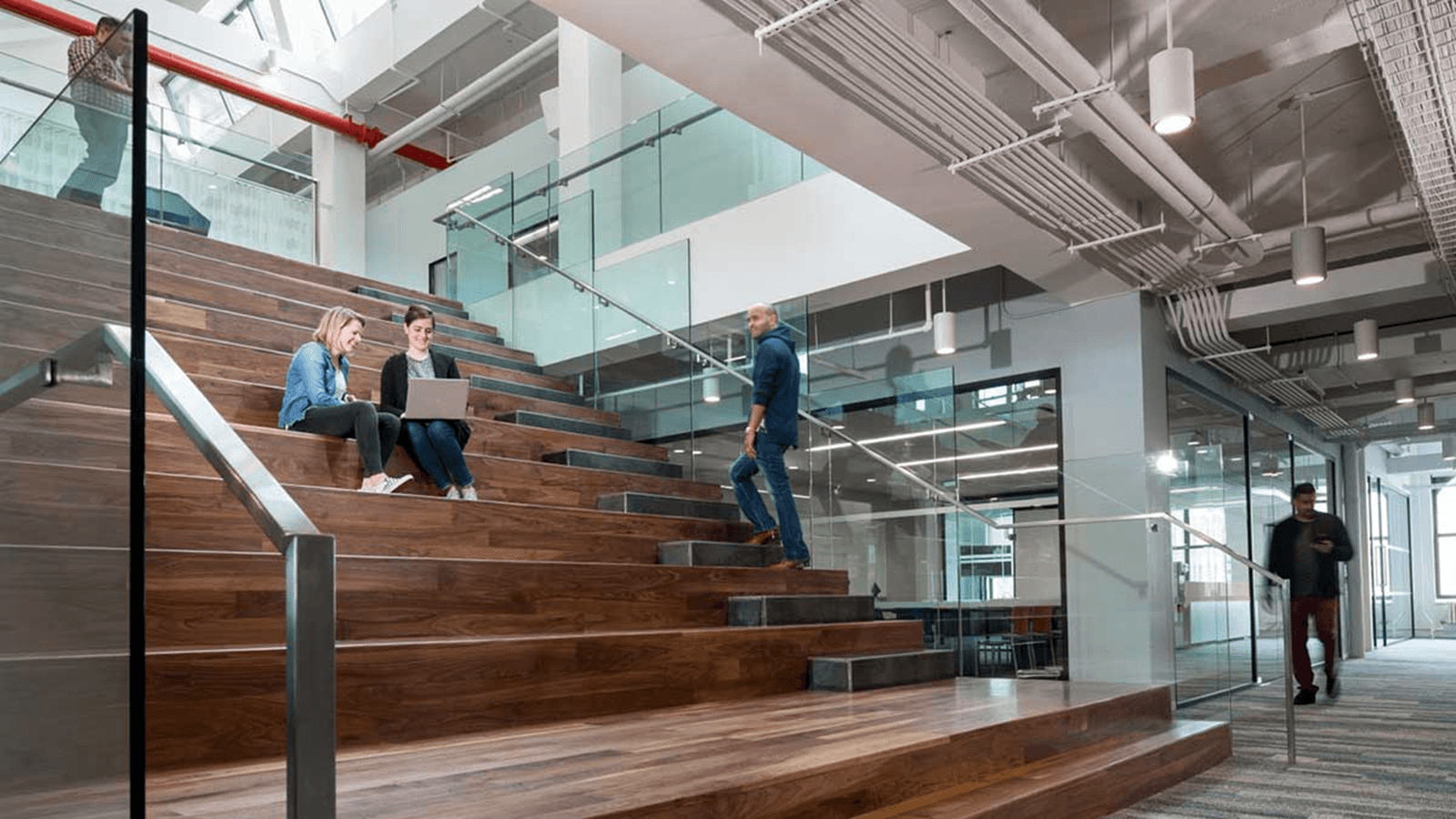
But the surprises didn't stop there. There was a clear need for a town hall space, a central hub for the entire company to come together. The design solution? A large feature stair wide enough to provide stadium seating for company-wide gatherings. Despite some initial doubts, this feature stair has become a central and cherished element of the office. It's a place where people not only meet but also linger after discussions, fostering cross-team learning and camaraderie.
The transformation of Yodle's workspace has had a ripple effect beyond its walls. As word of the innovative and engaging new office spread, the company saw an uptick in both the quantity and quality of job applicants.
Considering how Adobe and Yodle had to jazz up their office spaces, it's pretty much the same deal for everyone. You know, like when you start with "Hey, we need a place where we can throw ideas around," but end up learning a ton about your team and why everyone works the way they do.
Here's the scoop on getting your team involved in shaping a space they will love. First off, you need to play detective with your crew and ask some real-talk questions:
Creating a space isn't just about dropping cash on some fancy chairs and desks. It's a big-time investment that can totally transform how productive your team is, how happy and engaged they feel, how you snag top talent, and how your brand comes across. There are a ton of ways to design a space, but don't just copy what all those trendy start-ups are doing. Efforts should involve designers, leadership, real estate teams, and regular end-users. Keeping the bigger picture in mind while attending to specifics creates offices where people and business thrive together.
At Workscape Designs, we believe your office should be your company’s greatest competitive advantage, not a logistical headache. As the stories of Adobe and Yodle show, the transition from a "fad-following" layout to a strategic environment requires more than just new furniture—it requires a partner who understands the data behind human behavior. Whether you are looking to draw employees back to the office or scale your culture for the next five years, we are here to help you navigate the 7 Factors of design.
Schedule a consultation with Workscape Designs today and let’s turn your square footage into a high-performance business tool.
Company leaders should think strategically about office design rather than blindly follow the latest fads. Too often, "modern" is used as a shorthand for "open," but a trendy layout that ignores your team’s actual workflows is a liability, not an asset. Work environments reflect and reinforce core values through layout, aesthetics, and functionality. When a space is designed with intention, it becomes a silent partner in your business—a physical tool used to influence behaviors, boost morale, and drive bottom-line performance.
For instance, open floorplans aim to encourage collaboration, a virtue for many modern companies looking to break down silos. However, we’ve learned that complete openness often yields the opposite result: it reduces privacy and creates "noise fatigue," which actually hampers productivity and drives employees to wear noise-canceling headphones—the ultimate barrier to collaboration.
The solution isn't to retreat back to 1990s cubicles, but to find a dynamic equilibrium. This likely entails balancing open communal areas—designed for serendipitous "water cooler" moments—with enclosed quiet spaces for deep, concentrated work.
The "perfect" office doesn't exist in a vacuum; the optimal balance depends entirely on your specific work patterns. A high-intensity sales floor requires a different energy and layout than a software engineering firm or a creative branding agency.
To move beyond guesswork and "Pinterest-inspired" decorating, an organization must take a data-driven approach. You can systematically evaluate your team’s unique needs by applying a “Collaboration and Quiet Index” across seven key spatial attributes. By scoring your current or future space against these metrics, you transition from "subjective taste" to "objective strategy."
This isn't just about where the building is, but where a team sits within the floorplate. Central visibility creates a "town square" vibe, perfect for departments like HR or IT that everyone needs to access. Conversely, distributed team zones (or "neighborhoods") allow specific departments to build their own micro-cultures and reduce "cross-talk" noise from unrelated teams.
Enclosure dictates the level of acoustic and visual privacy. Open layouts prioritize "information osmosis"—hearing things by accident that help you do your job. Closed rooms are for the "deep work" Yodle identified. The goal is to provide a gradient: from totally open desks to semi-private booths, to soundproof pods.
This deals with the "Goldilocks" of human interaction. High-exposure areas are public gathering spots (like Adobe’s transparent hubs) where you expect to be seen and interrupted. Low-exposure areas are tucked away nooks or "library zones" where an employee can work with their back to a wall, reducing the "cocktail party effect" and anxiety of being watched.
As Adobe discovered, space must support both in-person and virtual collaboration. This factor asks if a space is "analog-first" (whiteboards and face-to-face) or "digital-first" (integrated screens for Zoom/Teams). Great design ensures that a group sharing a screen doesn't disturb those using personal devices nearby.
This defines the "rules of engagement." Reservable spaces provide certainty for planners and high-stakes meetings. First-come-first-served (hot-desking or touchdown spots) encourages spontaneity and movement. Balancing these prevents "squatting" in meeting rooms while ensuring people have a "home base" when they need it.
Humans have a biological need for "Prospect and Refuge." Panoramic views (windows, long vistas across the office) provide a mental break and inspire big-picture thinking. Focused sights (staring at a task-lit desk or a solid wall) help the brain enter a "flow state" by removing peripheral visual distractions.
One size never fits all. Large assemblies (like Yodle’s stadium seating) are for cultural alignment and "Town Halls." Small huddles (2-4 people) are where the actual engine of work happens. A common mistake is building too many 10-person boardrooms that are usually occupied by only two people.
Analyzing regular activities like standing meetings using these metrics provides concrete vocabulary for articulating needs beyond generic calls for “more collaboration.” Surveys, workshops, and other input can also illuminate trends.
Adobe, a company that faced similar challenges to what you might be experiencing right now. They were looking to reinvent their office space in Midtown Manhattan, seeking to create an environment that would not only draw employees back into the office but also support their dynamic work culture.
The starting point for Adobe—and a great one for any company—was to recognize that simply asking for "more collaborative space" wasn't enough. Instead, they needed to understand the specific needs and preferences of their employees. What Adobe did next was both insightful and effective, and it's a strategy that could benefit your company as well.
Firstly, it's about truly knowing your employees. Who are they? What are their workstyles? How do they interact with the space? Adobe took a data-driven approach to answer these questions, engaging directly with their employees to gather feedback on what matters most to them in a workspace.
They found out that employees craved a space that was not only functional but also had a sense of transparency and connection to the activities happening around them. They wanted technology-integrated spaces that allowed for seamless sharing of ideas, supporting both in person and virtual collaboration. Additionally, they expressed a desire for informal and flexible meeting areas for spontaneous teamwork.
While open-plan offices are popular, Adobe's employees also highlighted the importance of having clear boundaries and distinct areas for different teams and tasks. This nuanced understanding of their needs informed the redesign process, ensuring that the new office would truly resonate with those who use it every day.
Yodle was at a crossroads: they wanted to maintain the vibrant energy of their start-up roots while also accommodating for future expansion. Their existing space, which had developed haphazardly over time, was bursting at the seams. The layout led to teams being scattered with no central areas for collaboration, and executives were cut off in isolated offices. This disjointed environment was holding them back from transitioning smoothly from a start-up vibe to the sophistication of a mature business.
Approaching this challenge, Yodle undertook a rapid visioning exercise, focusing on the seven key attributes of effective workspaces. This process brought several insights to light. For instance, the developer teams, who were often engaged in fast-paced projects requiring close coordination, discovered they were more collaborative than they had initially thought. They also recognized the need for quiet zones to focus on intensive tasks.
To cater to these needs, the new design introduced innovative solutions like a "quiet car"—a dedicated semi-enclosed area that allowed for uninterrupted work on demanding projects. It wasn't just about creating a silent zone; it was also about signaling respect for deep work, visually indicating that when someone was in that space, they needed to work without distractions.
But the surprises didn't stop there. There was a clear need for a town hall space, a central hub for the entire company to come together. The design solution? A large feature stair wide enough to provide stadium seating for company-wide gatherings. Despite some initial doubts, this feature stair has become a central and cherished element of the office. It's a place where people not only meet but also linger after discussions, fostering cross-team learning and camaraderie.
The transformation of Yodle's workspace has had a ripple effect beyond its walls. As word of the innovative and engaging new office spread, the company saw an uptick in both the quantity and quality of job applicants.
Considering how Adobe and Yodle had to jazz up their office spaces, it's pretty much the same deal for everyone. You know, like when you start with "Hey, we need a place where we can throw ideas around," but end up learning a ton about your team and why everyone works the way they do.
Here's the scoop on getting your team involved in shaping a space they will love. First off, you need to play detective with your crew and ask some real-talk questions:
Creating a space isn't just about dropping cash on some fancy chairs and desks. It's a big-time investment that can totally transform how productive your team is, how happy and engaged they feel, how you snag top talent, and how your brand comes across. There are a ton of ways to design a space, but don't just copy what all those trendy start-ups are doing. Efforts should involve designers, leadership, real estate teams, and regular end-users. Keeping the bigger picture in mind while attending to specifics creates offices where people and business thrive together.
At Workscape Designs, we believe your office should be your company’s greatest competitive advantage, not a logistical headache. As the stories of Adobe and Yodle show, the transition from a "fad-following" layout to a strategic environment requires more than just new furniture—it requires a partner who understands the data behind human behavior. Whether you are looking to draw employees back to the office or scale your culture for the next five years, we are here to help you navigate the 7 Factors of design.
Schedule a consultation with Workscape Designs today and let’s turn your square footage into a high-performance business tool.

Want a Thriving Business? The Connection Between Workspace Aesthetics and Client Trust

Double Your Output: How Workspace Lighting Affects Employee Efficiency

